

Roadcheck 2026: Why One in Three Trucks Got Grounded
The Numbers That Should Alarm Every Fleet Manager
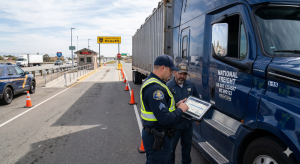
Something shifted during the 2026 CVSA International Roadcheck — and not in a good direction. The three-day enforcement blitz wrapped up on May 14. The final data told a story that should concern every fleet safety professional in North America.
The 2026 Roadcheck produced 15,952 inspections, 27,222 violations, and a final out-of-service rate of 32.8%. For context, last year’s event produced 56,178 inspections. The vehicle out-of-service rate was 18.1%. The driver out-of-service rate wa 5.9%. In one year, the OOS rate jumped nearly 15 percentage points. Roughly one in three trucks that rolled through an inspection station this May got grounded on the spot. PTI4YOUFirst Call Logistics
The Commercial Vehicle Safety Alliance designated two focus areas for 2026: ELD tampering and cargo securement. Those choices were deliberate — and the violation data proved them right. But as the numbers unfolded day by day, a more complicated picture emerged. The focus areas drew more inspector attention, but they also revealed a fleet compliance culture with cracks running deeper than any single enforcement week could fix.
ELD Tampering: The Focus Area That Bit Back
The ELD side of this year’s Roadcheck was always going to be aggressive. According to CVSA, falsification of records of duty status was the second most-cited driver violation across all FMCSA inspections in 2025, at 58,382 total violations. Five of the top ten driver violations in the 2024 FMCSA enforcement dataset were hours-of-service or ELD related. FreightWaves
Inspectors were not simply scanning screens for obvious edits. They were cross-referencing records of duty status against supporting documents — fuel receipts, bills of lading, toll records — and flagging specific anomalies. Those anomalies included driving time recorded while the device was in an unidentified or disconnected state, edits to logs without required annotations, and location data that didn’t align with recorded driving time. FreightWaves
A separate pressure also hit fleets that weren’t fully prepared. Between January and March 2026, the FMCSA removed 27 distinct electronic logging devices from its authorized registry — an 80% increase in device decertification compared to 2025. After a 60-day grace period from each revocation date, a carrier still operating a revoked device is treated by FMCSA as running without an ELD at all — meaning full out-of-service exposure on every mile. Fleets that missed those revocation notices, or assumed someone else was tracking them, paid the price during Roadcheck week. PTI4YOUFreightWaves
Adding to the enforcement stakes, CVSA’s updated North American Standard — effective April 1, 2026 — now separates a false log from a false log caused by ELD tampering. When tampering is confirmed and a rest period cannot be determined, the driver is placed out of service for 10 hours immediately, with no warnings. This escalation is new in 2026. Taylor Distributing
Cargo Securement: Not Just a Flatbed Problem
On the vehicle side, cargo securement was the named focus — and the data backed up why CVSA picked it. In 2025, CVSA cited 18,108 violations for cargo not secured against leaking, spilling, blowing, or falling, plus another 16,054 violations for unsecured vehicle components or dunnage. The BRAKE Report
Inspectors during the 2026 blitz were checking far more than whether straps were present. They examined tiedown condition, looking for fraying, kinking, and field repairs that knocked working load limits below spec. They checked anchor points for cracks and corrosion, and they verified that dunnage was actually secured to the trailer — not just sitting loosely in the bed. Keynnectlogistics
Still, it was brakes — not the named focus area — that continued driving the worst individual inspection outcomes. CVSA’s 2025 Roadcheck results identified 3,304 out-of-service brake system violations, representing 24.4% of all vehicle OOS findings, and an additional 2,257 violations for 20% defective brakes. Combined, brake-related violations made up more than 41% of all vehicle OOS outcomes — a share that has held above 40% in every recent Roadcheck cycle, regardless of the year’s named focus area.s The BRAKE Report
What Comes Next for Fleets That Got Hit
The enforcement does not stop when the 72-hour window closes. The FMCSA uses Roadcheck data to identify carriers for targeted terminal audits. Fleets that received multiple OOS orders during the blitz should expect a formal compliance review letter within 60 to 90 days, requiring 90 days of DVIRs, maintenance records, and ELD data. Beyond audits, out-of-service violations carry higher severity weights than non-OOS findings, and multiple violations within a single inspection can increase the overall impact on a carrier’s CSA score. PTI4YOUFirst Call Logistics
For fleets that came through Roadcheck clean, the work is not finished either. CVSA runs additional enforcement pressure throughout the year. Operation Safe Driver Week is scheduled for July 12–18, 2026, with a focus on improving driving behaviors through education and traffic enforcement. CVSA Brake Safety Week runs August 23–29, 2026. Gennaro
The Fleetio blog’s Roadcheck takeaways offer a practical compliance checklist for fleets still assessing their Roadcheck exposure. The FMCSA’s ELD registered devices list remains the first place fleet managers should check before the next dispatch cycle.
The Bigger Picture: Year-Round Compliance Is the Only Strategy
The 32.8% out-of-service rate from Roadcheck 2026 is not simply a story about one bad enforcement week. It is a signal that too many fleets are still treating safety compliance as an event-driven exercise rather than a continuous program. Inspectors run the same 37-step process year-round. The focus areas change. The checklist doesn’t.
The carriers that came through Roadcheck week clean were not the ones who scrambled to prepare in May. They were the ones whose pre-trip inspections, ELD audits, and maintenance records reflected what they do every single day.
Also read: Stop Guessing: The True Cost of 10-Year-Old Trucks

