

Class 8 Orders Just Went Beast Mode and Nobody Told the Summer Slump
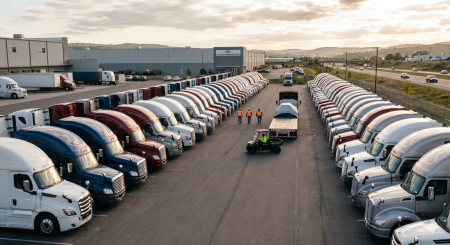
For most of the last two years, the Class 8 order board read like a doctor’s waiting room: quiet, a little tense, everybody avoiding eye contact. Then May happened, and somebody apparently spiked the punch.
North American Class 8 net orders rocketed to roughly 26,500 units, according to ACT Research — up a frankly absurd 103% year over year and 12% from April. FTR clocked it at 26,600 units, a number sitting 56% above the 10-year May average of around 17,000. That’s not a recovery. That’s a fleet-wide group text that said “buy trucks now” and everyone actually read it.
And here’s the kicker: May is supposed to be slow. Order season traditionally winds down as summer kicks in. Somebody forgot to send the market the memo.
So who let the orders out?
A few things converged at once, and unusually, they’re all pointing the same direction.
Freight rates are firming up. Utilization is climbing. Capacity is tightening. Trucks that fleets babied through the downturn are finally aging out and demanding replacement — there’s only so long you can keep a high-mileage tractor on the road with duct tape and optimism. May marked the sixth straight month of year-over-year growth, with trailing 12-month orders pushing past 312,000 units.
Then there’s the wildcard everyone in the room is whispering about: the EPA 2027 emissions standards. New rules mean new, more expensive, more complex engines on the horizon. And nothing motivates a fleet CFO quite like the words “buy it before it gets pricier and weirder.” A moderate pre-buy is clearly underway, as fleets rush to lock in current-spec iron before the regulatory goalposts move.
The buzzkill in the fine print
Before you start drafting your capacity-expansion victory speech, two splashes of cold water.
First, these are preliminary numbers. Final figures have a way of shaving the edges off a great headline, so treat 26,500 as a strong signal, not gospel.
Second — and this is the awkward one — a chunk of this demand is borrowed from the future. Pre-buy is exactly that: orders pulled forward ahead of EPA 2027. Every truck bought early to dodge the new engines is a truck that won’t be bought later. Analysts are already warning that the pace will cool as summer seasonality reasserts itself and 2026 build slots run out. Strong spring, potential hangover. We’ve seen this movie before.
What it means for your fleet
If you’re running a large fleet, the takeaways are refreshingly concrete.
Build slots are filling up fast, so if a 2026-spec order is in your plan, “later this quarter” may already be “too late.” Lead times are the new battleground. If you’re weighing a pre-buy of your own, run the actual math on EPA 2027 cost and complexity versus financing today’s iron, the pre-buy stampede is rational, but “everyone’s doing it” is not a spec sheet. And if you’re on the selling side of used equipment, a hot new-truck market tends to firm up trade and resale values, so it’s not a bad window to move tired assets.
The bottom line: the Class 8 market just posted the kind of month that makes analysts double-check their spreadsheets. Whether it’s the start of a genuine up-cycle or a regulation-fueled sugar rush, the smart play is the same — order early, model the 2027 math honestly, and don’t mistake a great May for a guaranteed great year.
The summer slump might still show up. It’s just going to have to find a parking spot first.

