

How New June 2026 OEM Software Boosts Fleet Uptime
Tackling the Costly DEF Inducement Crisis
Maximizing asset availability remains a core goal for modern transportation operations. Consequently, major commercial truck manufacturers are deploying aggressive technology upgrades to alleviate maintenance bottlenecks. Specifically, new software updates from industry leaders in June 2026 are targeting costly diagnostic delays. Therefore, fleet maintenance directors can expect immediate relief from unexpected vehicle derates and shop visits.
Diesel exhaust fluid systems have long been a primary source of frustration for over-the-road fleets. However, stringent federal environmental mandates historically forced vehicles into restrictive five-mile-per-hour limp modes during component failures. As a result, operators frequently faced catastrophic towing charges and missed delivery windows for minor sensor faults.
Daimler Eases the Pressure on Detroit Engines
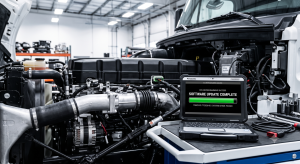
To address these widespread maintenance challenges, Daimler Truck North America launched a massive software overhaul in mid-June. The initiative targets more than 300,000 in-service Freightliner and Western Star trucks powered by Detroit DD13 and DD15 engines. Furthermore, the new coding increases the final inducement speed limit from 5 mph to 25 mph.
This modification gives drivers sufficient velocity to safely reach a repair facility without requiring an emergency roadside rescue. Additionally, the revised software extends the time window before final inducement triggers for component-related issues. Consequently, small business owners and large carriers alike will enjoy lower operating costs and drastically reduced downtime.
Volvo Revolutionizes Parked Software Deployments
Meanwhile, Volvo Trucks North America is addressing uptime from a different technological angle. The manufacturer recently announced an advanced over-the-air update system that operates during overnight hours. Previously, drivers had to remain present inside the cab during the entire software installation process.
Moreover, the new platform allows updates to deploy seamlessly while the asset sits parked and empty. Thus, maintenance teams can coordinate fleet-wide enhancements without disrupting tight delivery schedules or driver rest cycles. Ultimately, these June 2026 OEM developments prove that smarter data management is transforming heavy-duty fleet operations.
Also read: Utility Trailer’s SmartWay Features: A Smarter Path to Better Fuel Efficiency

