

Benchmarking Your Fleet’s MPG: A Practical First Step
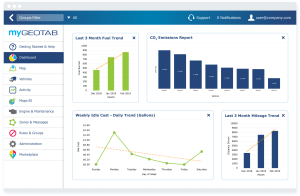
Fuel is the expense that never stays still. Prices rise and fall, driving conditions change, and every driver handles the throttle differently. As a new fleet manager, you cannot control the price at the pump. However, you can absolutely control how efficiently your fleet uses every gallon it buys. That starts with knowing where you stand — and that means benchmarking your fuel economy.
Benchmarking is simply the process of measuring your current performance and comparing it to a standard. For fuel efficiency, it means calculating your fleet’s miles per gallon (MPG), comparing it to industry averages, and then tracking whether your decisions actually move the number. Without a baseline, you are flying blind and making expensive guesses.
Why Fuel Deserves Your Full Attention
Fuel is not just another line item. According to the American Transportation Research Institute’s 2025 Operational Costs of Trucking report, fuel costs averaged 48 cents per mile in 2024. That figure dropped 13 percent from 2023 — welcome news — but it still represents the single largest variable expense in your operating cost structure. At 100,000 miles per year per truck, that adds up to roughly $48,000 per vehicle in fuel alone.
Furthermore, even a modest improvement in MPG delivers significant savings. According to Geotab’s fuel efficiency research, driver behaviors like speeding, idling, and harsh braking can impact fuel consumption by up to 30 percent. That is not a small margin. For a mid-sized fleet, a 10 percent improvement in fuel economy can save tens of thousands of dollars every year.
What the Industry Average Actually Looks Like
Before you can benchmark your fleet, you need to know what good looks like. The North American Council for Freight Efficiency (NACFE) publishes an annual Fleet Fuel Study that is the most widely cited benchmark in commercial trucking. Their 2024 study, which tracked 14 major fleets operating 75,000 trucks, reported an average fuel economy of 7.77 MPG in 2023. The national average for combination trucks, by comparison, sits at 6.9 MPG.
That gap matters. NACFE calculated that fleets achieving 7.8 MPG saved an average of $6,831 per truck per year compared to the national average — assuming 100,000 annual miles and the five-year average diesel price of $3.62 per gallon. Across 75,000 trucks, those same fleets saved a combined $512 million in fuel costs in 2023 alone. The lesson is clear: higher MPG is not just an environmental win — it is a serious competitive advantage.
Those benchmarks are for long-haul, high-utilization fleets. If your operation involves regional routes, shorter hauls, or significant city driving, your baseline will naturally be lower. NACFE notes that the shift toward regional and hub-and-spoke operations continues to pull average MPG down across the industry because shorter routes involve more non-interstate driving and stop-and-go conditions. Know your operation type before you compare your number to a long-haul benchmark.
How to Calculate Your Fleet’s MPG Baseline
Establishing a baseline is straightforward. Start by pulling three to six months of fuel purchase data. Divide the total miles driven by the total gallons consumed during that period. That gives you your fleet-wide average MPG.
Next, break that number down by individual vehicle. One truck running at 5.5 MPG while the rest average 7.0 MPG is a signal worth investigating. That outlier could have a maintenance issue, a heavy-footed driver, or a route that involves excessive idling and city driving. You cannot find those problems if you only look at fleet averages.
Also track your fuel cost per mile alongside MPG. According to ATRI’s benchmarking data, the industry average sat at $0.481 per mile in 2024. That figure gives you a dollar-based metric that ties directly to your budget and is easy to report to leadership.
The Variables That Move the Number
MPG does not exist in isolation. Several factors push it up or down, and as a new manager, you need to understand which ones you can actually control.
Speed is the most powerful variable. According to Geotab’s fuel efficiency guide, for every increment of roughly five miles per hour driven over 60 mph, a truck’s fuel economy drops measurably. Maintaining optimal highway speeds is one of the simplest, lowest-cost ways to improve fleet MPG — and it costs nothing to implement beyond a speed policy and consistent enforcement.
Idle time is the next culprit. A long-haul truck sitting at idle burns roughly 0.8 gallons of diesel per hour. Drivers who idle for climate control, breaks, or habit are quietly draining your fuel budget. Samsara’s fleet telematics platform reports that customers using real-time idle alerts have saved millions of dollars in fuel by identifying and reducing unnecessary idling — in one documented case, over $3 million in annual fuel savings for a single carrier.
Maintenance is the third lever. Under-inflated tires alone can reduce fuel economy by up to 3 percent, according to Geotab. Dirty air filters, worn injectors, and degraded engine oil all chip away at efficiency over time. A consistent preventive maintenance schedule protects your MPG as much as it protects your equipment.
Finally, aerodynamics and equipment spec play a long-term role. NACFE tracks 86 fuel-saving technologies across its study fleets, and the overall adoption rate of those technologies has grown from 17 percent in 2003 to 42 percent in 2023. Solutions like trailer skirts, side fairings, low rolling resistance tires, and automatic tire inflation systems all contribute to measurable fuel savings. Most of these are available as aftermarket additions, so you do not need to wait for a new truck order to start benefiting.
Using Telematics to Track and Improve MPG
Manual fuel tracking gets you a baseline. Telematics takes you further. Modern fleet telematics platforms from providers like Geotab, Samsara, and Motive give you real-time visibility into the specific behaviors and conditions that affect fuel economy. They track speeding events, idle time, harsh acceleration, RPM patterns, and route efficiency — all of which feed directly into your MPG number.
More importantly, telematics data lets you coach individual drivers. Instead of a general company-wide policy reminder, you can show Driver A that his idle time averaged 4.2 hours per day last week, or that Driver B’s average highway speed is consistently 7 mph above the fleet threshold. That kind of specific, data-backed feedback is far more effective than a blanket memo. Geotab’s own benchmarking data shows that fleets using telematics for fuel management typically see a 30 to 40 percent reduction in idling and speeding events after consistent coaching.
Setting Realistic Improvement Goals
Once you have your baseline and understand what is driving your current number, set a realistic improvement target. For most new fleet managers, a 5 to 10 percent improvement in fleet-wide MPG over the first 12 months is achievable through driver coaching, idle reduction, and basic maintenance discipline alone — without any new equipment investment.
After that first year, you will have enough data to identify where additional investment makes sense. Perhaps a subset of your trucks would benefit from trailer aerodynamic devices. Perhaps your highest-idle routes need auxiliary power units to reduce overnight engine run time. Decisions like those should be driven by data, not guesswork.
The goal of benchmarking is not to produce a perfect number on day one. The goal is to establish a starting point, build a habit of measurement, and create a feedback loop that makes improvement visible. When your CFO asks why fuel costs are up this quarter, you want to have a data-backed answer — not a shrug.
Fuel will always be your fleet’s biggest variable cost. The managers who track it closely are the ones who control it.
Also read: Stop Fuel Card Fraud Before It Costs You Thousands

