

Ready-Mix Runs on Trust: What the Geiger Ready-Mix Story Says About AI Dash Cam ROI
Few vehicles on the road are harder to drive safely than a loaded concrete mixer. Ten yards of wet concrete sitting high in a rotating drum gives a mixer truck a center of gravity that shifts constantly, an aggressive off-road duty cycle, and a delivery clock that never stops. That combination is exactly why IntelliShift’s new customer story on Geiger Ready-Mix is worth ten minutes of any fleet manager’s time.
A five-generation fleet with a modern problem
Geiger Ready-Mix is not a startup experimenting with technology. The family has been in the construction materials business in the Kansas City area since the 1890s, and the ready-mix company itself dates to 1949. Today it runs six plants across Leavenworth, Kansas City, De Soto and Olathe in Kansas, plus Liberty and Lee’s Summit in Missouri.
A footprint like that creates the classic ready-mix safety problem: dozens of heavy, high-profile trucks operating out of multiple yards, on tight schedules, on job sites where the “road” is often mud and gravel. Supervisors cannot be everywhere. And when something goes wrong, the fleet usually finds out from a phone call rather than from data.
Why video changed the math
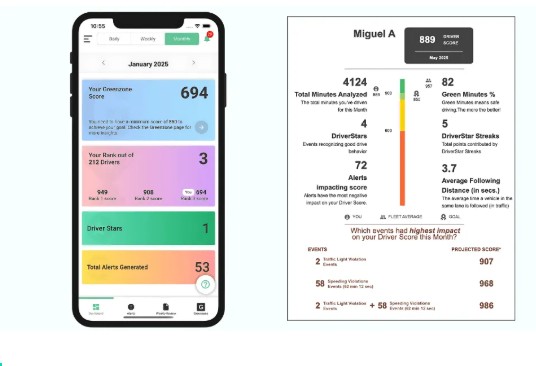
The reason AI dash cams have taken over the safety conversation is not that they record crashes. It is that they change driver behavior before the crash. IntelliShift’s AI Dash Cam 400 launch data — drawn from a 30-day study of 8,054 vehicles — reported a 9x reduction in harsh driving events (hard braking, speeding and rapid acceleration) when cameras were paired with driver scorecards. The camera alone is a recorder. The camera plus a scorecard plus a coaching conversation is a behavior change program.
Other IntelliShift customers have posted results in the same range: Fox Electric cut vehicle accidents 85% in six months, Day & Nite reduced rear-end collisions 75% and in-cab phone use 90%, and Paraco Gas reported a 53% accident reduction. Those are service and delivery fleets, but the mechanism transfers directly to mixer operations.
The ROI case for a mixer fleet
For ready-mix specifically, the return shows up in four places:
- Rollover avoidance. A single loaded mixer rollover can run well into six figures once you count the truck, the load, the cleanup and the downtime — before any injury claim.
- Exoneration. Mixers are large, slow and visually memorable, which makes them magnets for nuisance claims. Forward-facing footage settles fault in minutes instead of months.
- Insurance leverage. Documented harsh-event trends and coaching records give a fleet something concrete to bring to renewal negotiations.
- Job site behavior. Much of the risk in this industry happens at low speed around the truck. The NRMCA safety materials and OSHA’s long-running partnership with the association both emphasize that mount/dismount, chute handling and backing incidents drive a large share of injuries.
The takeaway for your fleet
The pattern in every one of these stories is the same, and it has almost nothing to do with hardware specs. Fleets that get real ROI from AI video do three things: they tell drivers exactly what is being measured and why, they coach on trends rather than ambushing people with clips, and they tie the scorecard to something drivers actually care about. Fleets that skip those steps end up with an expensive video archive and a frustrated driver roster.
Read the full case study on IntelliShift’s site, then ask the harder question at your own operation: if a mixer rolled tomorrow, would you know why?

