

Spare Fuses and Other Ghosts: FMCSA Is Finally Cleaning Out the Junk Drawer
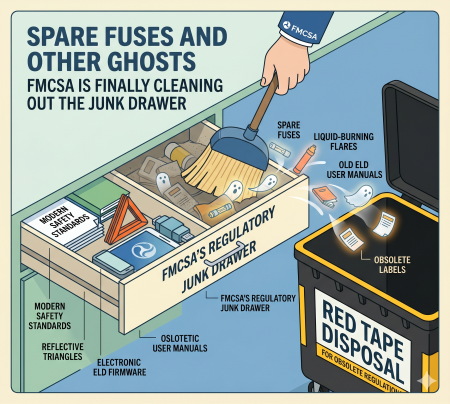
Every fleet has that one toolbox drawer. The one with a flashlight that doesn’t work, a fistful of fuses for a truck you sold in 2019, and an instruction manual nobody has opened since the Clinton administration. Turns out the federal government had one too — except theirs was the size of the Code of Federal Regulations, and you were legally required to keep restocking it.
That’s changing. Transportation Secretary Sean P. Duffy rolled out 52 deregulatory actions across FHWA, NHTSA, and FMCSA, aimed squarely at the rules that have been quietly cluttering up compliance binders for decades without doing anything useful. The pitch: strip out the decade-old, redundant, real-world-irrelevant stuff, save the industry millions, and stop generating violations for things that never mattered.
Here’s the part that’ll make you laugh, then sigh.
The greatest hits of regulatory clutter
As of April 20, 2026, commercial drivers are no longer required to carry spare fuses for required equipment. Why? Because modern trucks don’t blow fuses the way a 1978 cabover did. The rule had been sitting on the books long enough to qualify for a pension.
It gets better. FMCSA is also scrapping the requirement to carry a paper copy of an ELD’s operator manual — you know, the manual that lives on the internet, on the device, and in approximately fourteen browser tabs. It’s striking obsolete references to “water carriers,” because FMCSA doesn’t regulate boats. It’s killing the grandfather clause from a vision-waiver study program that wrapped up so long ago most of the participants have retired. And the old standbys — liquid-burning flares, redundant impact-guard labeling — are headed for the regulatory recycling bin too.
None of these made your trucks one ounce safer. They just gave a roadside inspector one more box to check and one more reason to write you up.
Why this actually matters (beyond the comedy)
It’s easy to dunk on spare fuses, but the real story is the violation math. FMCSA itself has pointed out that burdensome, outdated rules generated tens of thousands of unnecessary violations — paperwork dings that ding your CSA scores, spook your insurer, and cost you driver time at the scale house, all for failing to carry a part nobody needed.
For a large fleet, “unnecessary violation” isn’t a rounding error. It’s audit exposure, it’s nuisance out-of-service time, and it’s the kind of thing a plaintiff’s attorney loves to wave in front of a jury when something unrelated goes wrong. Clearing the deadwood means fewer technical fouls that have nothing to do with whether your equipment is actually road-safe.
What your compliance team should do
Don’t pop the champagne and stop reading regulations — that’s how fleets get burned. Instead:
Update your driver vehicle inspection checklists and pre-trip materials so drivers aren’t getting flagged (or self-flagging) for gear they no longer need to carry. Brief your safety team on which specific provisions are gone and when each took effect, because the changes are phasing in on different dates. And keep an eye on the rest of the 52 actions as they move through rulemaking — “proposed” and “final” are very different animals, and you want to be acting on the latter.
The deregulation push is, in the truest sense, the government cleaning its junk drawer. Enjoy the lighter binder. Just remember the brakes, the hours, and the real safety rules are all still very much in there — and those inspectors didn’t lose their pens.

