

AI In-Cab Coaching Cuts Accidents. Here’s the Proof.
From Reactive to Real-Time: How Fleet Safety Is Changing
For years, fleet safety programs followed the same basic pattern. An accident happened, managers pulled video, they had a conversation with the driver, and everyone hoped it wouldn’t happen again. That approach was never really prevention — it was documentation. A growing number of fleets have replaced it with something fundamentally different: AI systems that intervene while the truck is still moving.
The results are starting to show up in the data. Dohrn Transfer Co., a less-than-truckload carrier based in Rock Island, Illinois, deployed driver-facing event recorders with AI from Samsara more than a year ago. Comparing the first quarters of 2025 and 2026, the company found that accidents dropped 15%, according to Robert Howard, the company’s president and chief operating officer. Howard credits much of that improvement to the way the system handles driver feedback before management ever gets involved.
The “Nudge First” Model
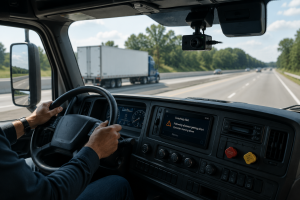
What makes the current generation of in-cab AI coaching different from earlier dashcam systems is the speed and frequency of feedback. According to Howard, the Samsara system issues real-time prompts the moment it detects risky behaviors — phone use, speeding, harsh braking, sharp cornering. Drivers receive in-cab audio alerts that correct the behavior on the spot, before the event ever escalates into a safety incident. Managers only learn about events that the driver hasn’t corrected on their own.
Howard described the dynamic simply: drivers get so many nudges before the system notifies the company that they have a real opportunity to self-correct. That loop matters because it shifts accountability toward the driver and reduces the administrative burden on safety managers who are often drowning in data they don’t have time to act on.
Samsara’s March 2026 announcement of expanded AI coaching features showed how far the technology has come. The company’s updated coaching model now evaluates more than 45 risk factors per event — including frequency, severity, trip conditions, and driver history — before deciding how to route an alert. That precision means drivers get coaching that is relevant to their actual patterns, not generic warnings that are easy to ignore.
What the Broader Data Shows
Dohrn’s experience aligns with what Samsara has documented across its larger customer base. Fleets with 175 or more vehicles that deploy the full AI safety suite — including dual-facing AI dash cams, in-cab alerts, and driver coaching — have seen crash rates fall roughly 73 percent over 30 months, according to Samsara’s fleet safety report. Fleets with 500 or more vehicles see even stronger results, with harsh events down 84 percent and mobile device use down 98 percent at the 30-month mark.
Insurers are paying attention. Alasdair MacKechnie, Head of Auto Liability at insurance firm Inigo, stated in Samsara’s announcement that sustained coaching through the platform can improve driver behavior, leading to fewer crashes, a reduction in loss activity, and insurance premium savings. That connection between coaching data and premium pricing is becoming a real leverage point for safety-conscious fleets.
What Fleet Managers Should Ask Before Buying
Not every in-cab AI system performs equally. Before committing, fleet managers should ask vendors how their risk model is trained, how quickly the system can distinguish a true safety event from a false positive, and whether coaching data integrates with their existing telematics platform. Managers should also ask whether the system supports manager-side coaching tools — not just driver-side alerts — because the most effective programs combine both.
For Dohrn, that combination — real-time driver nudges plus structured manager coaching workflows — is what moved the needle. A 15 percent accident reduction in a single year is not a rounding error. It is the kind of result that pays for the system many times over.

