

The Rising Secondary Market for Electric Trucks
Shift Toward Commercial Electrification
Adopting alternative powertrains is no longer just a futuristic compliance exercise for commercial vehicle operators. Consequently, heavy-duty fleets are rapidly adjusting their procurement strategies to include alternative fuel vehicles. Specifically, a newly released June 2026 CALSTART market intelligence report outlines a dramatic acceleration in zero-emission truck deployments. Therefore, understanding these evolving regional factors and total cost of ownership models is essential for fleet owners.
Analyzing the Massive Surge in ZET Deployments
The latest data reveals that zero-emission options accounted for 4.14 percent of all nationwide commercial truck deployments recently. However, this represents a massive leap from the mere 1.32 percent observed during the first half of the preceding year. As a result, market analysts are declaring that electrification has moved past the initial trial phase.
Much of this near-term growth is originating from highly specialized vocational sub-sectors. For instance, municipal electric refuse trucks and battery-powered terminal yard tractors are leading the charge in urban areas. Furthermore, these short-range, stop-and-go duty cycles perfectly match current battery-electric charging capabilities.
Navigating the Early Secondary Vehicle Market
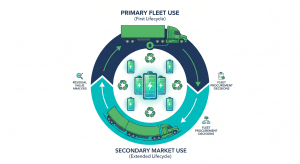
Meanwhile, a completely new development is reshaping how medium and heavy-duty carriers manage their long-term asset lifecycles. An early secondary market for pre-owned zero-emission vehicles is officially beginning to materialize. Previously, fleet managers worried about catastrophic battery degradation and nonexistent residual values when calculating depreciation.
Moreover, the emergence of used electric truck channels gives smaller operations a significantly more cost-effective entry point. Buyers can now acquire seasoned electric equipment without paying the staggering upfront premiums associated with factory-new models. Thus, smart fleet maintenance directors are capitalizing on these used units for predictable, local hub-and-spoke delivery routes.
Balancing Battery Electric and Hydrogen Powertrains
Selecting the correct powertrain remains highly dependent on a carrier’s specific regional geography and freight profiles. Additionally, regional clean vehicle incentive programs continue to play a foundational role in bridging total cost of ownership gaps.
While battery-electric variations dominate the local vocational markets, hydrogen fuel cell systems are gaining traction for long-haul Class 8 applications. Ultimately, reviewing the latest alternative fuel benchmarks guarantees that your organization stays competitive as emission rules tighten.
Also read: Roadcheck 2026: Why One in Three Trucks Got Grounded

