

Class 8 Orders Plunge as EPA 2027 Uncertainty Freezes Fleet Buying
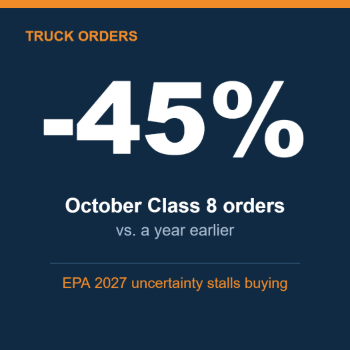
October is supposed to be the month fleets lock in next year’s trucks. This year, many of them didn’t.
Preliminary data from the two major commercial vehicle forecasters shows North American Class 8 orders collapsed in October:
- ACT Research estimated 13,500 orders, down 45% year over year.
- FTR Transportation Intelligence estimated 15,600 net orders, down 36% year over year and 24% from September.
FTR’s figure was nearly 50% below the 10-year October average of 31,089 units. Combined September and October orders were down 20% from the same period in 2025, a slow start to the 2027 order season. Volvo Trucks North America’s own October orders in the U.S. and Canada were the weakest of any month since July 2025.
It’s not a demand problem
The slowdown comes despite firmer freight rates, tighter capacity and aging equipment that needs replacing. Analysts at both firms say fleets want trucks. They just can’t price them.
The sticking point is the EPA’s 2027 nitrogen oxide (NOx) emissions regulation. The agency proposed changes earlier this year, but the final requirements are still unsettled. According to FTR, some truck makers have opened 2027 model-year order boards but may be holding back production slots or final pricing until the rules are clear.
The dollars at stake are significant. Under the proposed framework, FTR estimates nonconformance penalties could add $6,000 to $7,000 per engine if manufacturers pass them on. That compares with an estimated $8,000 to $12,000 premium for engines that fully meet the stricter standard. Actual costs will depend on the final rule and OEM pricing decisions.
Faced with that spread, many fleets are waiting for better pricing once the rules are finalized.
The pre-buy is over
The weak October follows a very strong year. FTR puts year-to-date Class 8 orders at 278,201 units through October, up 74% from 2025. Much of that was fleets buying ahead of the anticipated 2027 emissions changes.
That pre-buy has largely run its course. From here, orders will depend more on fleet profitability, replacement needs and confidence in equipment costs.
Margins are the other brake
Regulation isn’t the only thing slowing purchases. Fleets face higher diesel prices, rising insurance premiums and higher labor costs. Those pressures squeeze margins and shrink the capital available for new tractors, even as rates improve.
Trailers are getting the money instead
FTR says fleet capital spending may be shifting toward trailers rather than tractors in the near term. The trailer data backs that up. ACT reported preliminary September U.S. trailer orders of 42,700 units, up 311% year over year and 75% from August. The year-over-year jump is exaggerated by an unusually weak September 2025, but the seasonally adjusted total was still the third highest in 55 months.
Medium-duty is also holding up. ACT’s preliminary October orders for Classes 5-7 rose 14% year over year to 18,000 units.
Deferred, not canceled
FTR’s read is that many October purchases were postponed rather than abandoned. Replacement needs haven’t gone away, and tighter capacity supports equipment demand. That sets up a potential rush of orders once the EPA finalizes its requirements and OEMs firm up schedules and prices.
For fleets, that rush is the risk. If everyone waits for the same signal, build slots could fill quickly.
How to plan your 2027 equipment budget
- Model both price scenarios. Budget for a compliant-engine premium and a nonconformance-penalty scenario so you can move quickly either way.
- Talk to your dealer now. Ask which 2027 build slots are open, which are being held and when final pricing is expected.
- Rank your replacement list. Separate units that must be replaced in 2027 from those that can run another year with targeted maintenance.
- Price the cost of waiting. Older tractors burn more fuel and need more repairs. With diesel elevated, compare that against the potential savings of holding off.
- Look at trailers and medium-duty. If tractor timing is uncertain, trailer upgrades or medium-duty additions may deliver capacity sooner.
The bottom line
Fleets aren’t walking away from new trucks. They’re waiting for the EPA to tell them what those trucks will cost. Until that happens, expect order activity to stay choppy and plan for a potential crunch when clarity arrives.
ACT and FTR expected to release final October figures in mid-November.

